AI Doesn't Replace Judgment—It Reveals Whether You Have Any
AI is coming for our jobs, and honestly? That's not the part that scares me.
I believe AI will replace us. I believe we're living through a workplace revolution as significant as the Industrial Revolution of the early 1900s, and since we're standing in the middle of it, we won't know what the end result looks like until the dust settles—jobs will change, roles will disappear, and that's just the reality.
But here's what keeps me up at night: AI won't replace our judgment unless we let it, and from where I'm sitting, we're letting it.
I've spent six months building an enterprise AI framework for 2,200 public affairs professionals, and what I've learned is that everyone wants AI but almost no one wants to change.
Similarly, an exercise planning team brought me in to build a wargame framework that we could use as a best practice for the enterprise. This is something we've never attempted at this scale, so I built it—an AI framework where the fictional information environment shifts and reacts in real-time to participant decisions, where regional leaders respond dynamically based on their background and motivations, where the scenario actually breathes and evolves. And the response I got was, "That's not how we've always done it... can you just make our static templates…faster?"
They wanted AI to reduce their planning workload, not to rethink the work itself.
I've heard this my whole career in one form or another—that's not how we do it here—and automating that mindset doesn't fix anything, it just makes the resistance move quicker.
And then there’s my LinkedIn feed. Yes, the very place I’m sharing this post. But it’s drowning in "50+ AI tips to 10x your productivity" content, but nobody's asking the questions that actually matters.
Here’s what I learned at Air Force technical training back at DINFOS in 2007: you will live and sweat by the 5Ws and H—Who, What, When, Where, Why, How—and if you can’t answer those, you don’t have a story, period. The AP Stylebook is your Bible and you write for 8th grade and that is the foundation of everything.
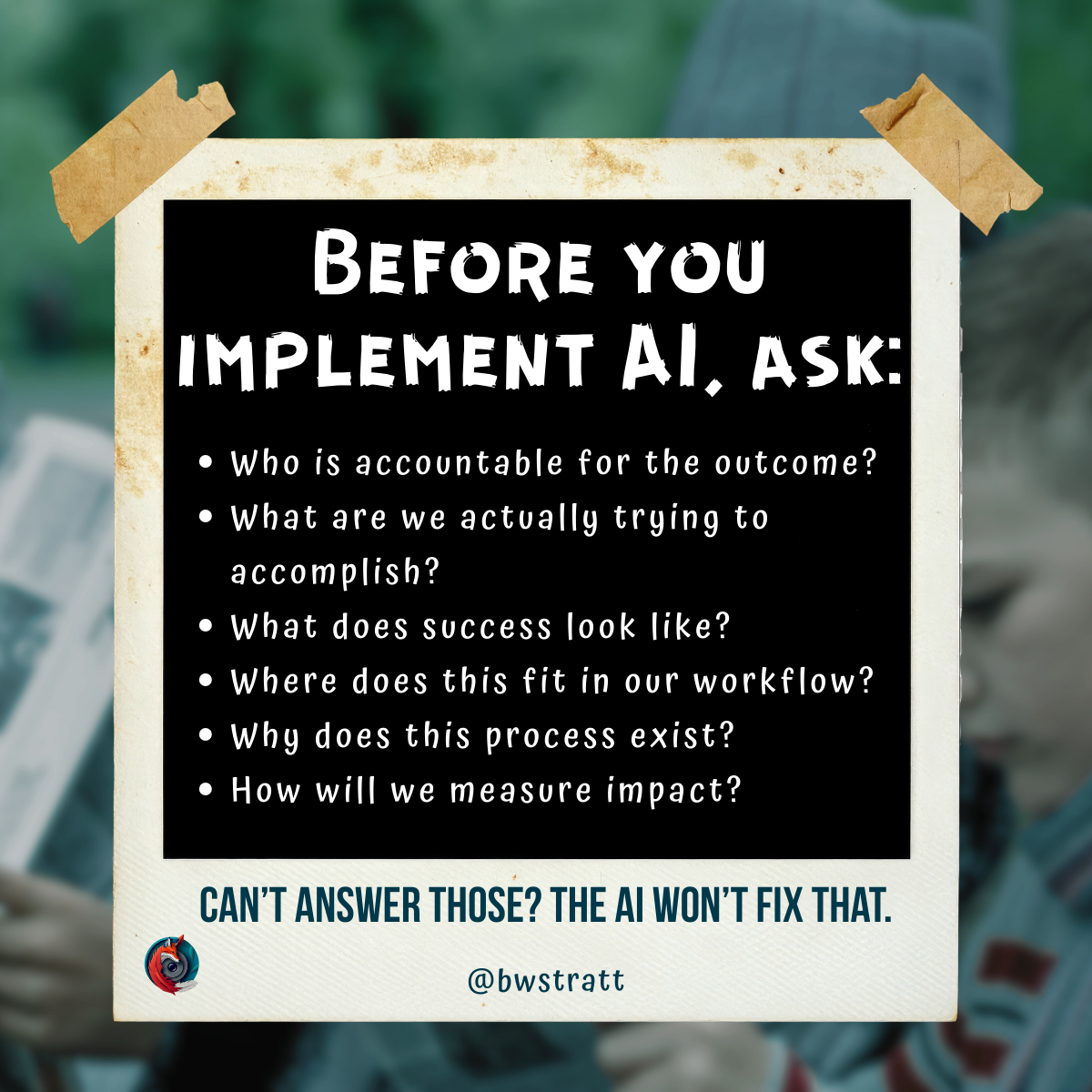
Oddly enough, I’ve found that those same rules apply here: before you ask "Can AI do this?" ask yourself what you're actually trying to accomplish, why the process exists, and who's accountable for the outcome. AI is a magnifying glass—point it at a clear process, you get traction; point it at chaos, you get chaos at scale.
AI can be everything we hope it will be, but only if we keep humans in the loop at every level and use it to make us smarter rather than more reliant. It should help us reach our goals, not replace our judgment, our agency, our ability to decide what matters. We can do this together. But humans have to have the last word.
Before you bolt AI onto your next workflow, run the 5Ws. If you can't answer them without the technology, you definitely can't answer them with it.